29 January 2009

The real reason


OK. The secret’s out. The real reason I drive a cab is because I like aeroplanes. Looking at them, flying in them, reading about them.

And, being a cabbie means that not only do I get to hang out at Canberra airport where I can watch planes landing, taking off and cruising around looking for a parking slot, I can earn enough money to fly in them every now and then.

Canberra International Airport (otherwise known as CIA) is perhaps a little too grandly named for its primary function, which is being one end of seven domestic air routes, mostly to the other capital cities. There used to be an international service to Fiji some years ago, which operated during the winter months, but that got cancelled due to poor attendance. Every now and then the airport management makes optimistic noises about flights to Singapore or New Zealand or Hobart, but the truth is that with Sydney airport a couple of hours up the road, offering regular services to just about everywhere in the world, Canberra can’t compete.

However, every now and then we get some international flights. If Sydney airport is closed in by weather, we’ll get an occasional diversion, such as the time the London flight came in late at night and sat around on the tarmac for six hours before the exhausted passengers were finally released. Or there will be visiting heads of state in colorful official jets.

BBJ DC9

It’s always worth while looking over at the RAAF VIP Squadron base on the other side of the main runway. Yesterday, I spotted an aging DC-9 in United States Navy livery, and while I was snapping telephoto photographs through the heat haze, there was a tremendous noise and a USAF KC-10 tanker aircraft landed. Presumably they will fly back home together, because there is no way a DC-9 could make it back over the Pacific alone.

The other aircraft in the background of the photograph above is one of Australia’s VIP transports, a Boeing Business Jet used to fly the Prime Minister and his media staff around. I suspect that we’ve used the same aircraft livery consultant, or maybe we bought some surplus aeroplane paint from the Americans.

26 January 2009

Aussie Cabbie


Australia Day, the 26th of January, commemorating the arrival of the First Fleet at what is now Sydney in 1788. Nowadays it’s a holiday, new citizens are sworn in, lord mayors make speeches, concerts are held on outdoor stages and the day finishes with a firework display.

Prime Minister Kevin Rudd did his bit for political solemnity by naming an Aboriginal Australian as Australian of the year. Mick Dodson promptly bit the PM on the bum by stating that the day should be moved to another date, because Aboriginal Australians regard the date as Invasion Day, a day of mourning for the original occupants of the land.

A bit rich, considering that 95% of todays Aboriginal Australians have European or Asian ancestors and wouldn’t be here at all if it wasn’t for their grandparents, but let’s not spoil a good Aussie whinge.

I wore my Australian flag tie, copping a few smiles and comments. Always nice to dress up a bit, at least as much as a cabbie uniform allows.

With the major Canberra celebration occurring on the weekend, in the form of a major free concert outside Parliament House, I was about as patriotic as it got today. I picked up a couple of young women with Australian flags on their cheeks, but as far as I could make out, they were Swedish tourists.

A few cars were flying Australian flags on plastic mountings, and here and there a green and gold t-shirt could be seen. But we’re not like other countries, making a meal out of national pride. You get more patriotic clothing and noises out of sporting contests than anything remotely political. Americans often have a flag flying outside their houses, but in Australia to have even a flagpole is a sign that there is something deeply wrong with the resident.

Americans make a fuss over presidential inaugurations, but in Australia, heads of state and heads of government are sworn in at private ceremonies in Government House. Maybe we’ll see a press photograph, maybe not. Nobody cares or waves a flag.

I finished my shift by taking a shortcut past Old Parliament House, now a museum. Across the road is the Aboriginal Tent Embassy, a motley collection of shacks and campfires, manned on a casual basis by people from the Sydney slum suburb of Redfern. The so-called embassy purports to represent the ancient sovereignty of Australia before European settlement, and the occupants want a treaty, their own state, massive reparations, freedom from taxation, rental income from ordinary Australians and special reserved seats in Parliament.

Most Aboriginal Australians live in cities, and are indistinguishable from the rest of the population, but the few who maintain a remnant of their tribal lives exist in small settlements remote from services, ridden with violence, drugs, sickness and crime. The most violent place on Earth, outside a warzone, is Palm Island in Queensland, an Aboriginal settlement with an economy almost entirely funded by government benefits.

In contrast to the sad and mixed remnants of the first Australians, I cannot help but think of the refugees who came here after the end of the Vietnam War. After sailing in leaky fishing boats through pirate waters, those that made it to Australia landed with nothing but the clothes on their backs.

A feature of citizenship ceremonies ever since, they and their children are the best investment Australia ever made. Doctors, lawyers, academics, solid business owners, they have set an example of hard work, devotion to study and attention to civic responsibility.

Successive waves of immigration have made Australia a melting pot and a rich stirfry of cultures. Nowadays we eat Thai tucker with chopsticks, flock to late-night kebab takeaways, and swoon over fresh naan bread in Indian restaurants. I need only look at my fellow taxidrivers to see the direction in which Australia is heading. We’re a world in microcosm and all the better for it.

I wear my Australian flag tie with pride. The British Union Jack features prominently, but, like our British heritage, it is fading. Within a generation we’ll likely have a new flag, a constitution that doesn’t have the British monarch playing a leading role, and a stronger confidence about our place in the world.

We’ve had our unpleasant moments, to be sure, but when I look at my nation, I see a peaceful land where riots are rare, civil war unknown, and all transitions of power are peaceful. Our American cousins might have begun their nation with a revolution, but we started with a signature. They had a bloody civil war, we had the Sheffield Shield cricket competition.

And may we keep it that way.

24 January 2009

My pleasure


Last night’s shift began on a high and I kept smiling all the way through. A normal enough Friday shift, and by normal I mean rest-of-the-year normal, not month-of-Sundays-January normal. There was plenty of work, and I was well into the afternoon rush, shuttling passengers to the airport.

Once again, the airport road system has changed, so that was an added challenge. Paul, my day driver, has been telling his passengers that the new layout is a joint venture between the airport and the taxi industry to make the trip as long as possible, and honestly the roads in and out are the most appalling series of loops and zig-zags and detours.

I dropped my passenger at the terminal, and headed back into the city empty. Once I was clear of the roadworks, my phone rang. The young lady on the other end identified herself as a Qantas representative, and while I was wondering about the various reasons for Qantas to call me, she totally floored me, telling me I’d won a prize in a travel writing competition.

This was a competition I’d entered well before Christmas, and after looking at the vast quantity and quality of the other entries, displayed online, I’d given up hope that my modest little piece about Guernsey had any chance at all.

But apparently it had ranked ninth, giving me a shot at one of the twelve prizes on offer. I’ll have my choice of four weekends away at an Australian resort, and a condition of accepting the prize is that I have to write and submit a 500 word article on the weekend, with photographs and video footage shot on the Nikon camera which comes as part of the prize.

“Ooooh, with pleasure!” I sighed into the phone.

So I’ll be a guest writer for Qantas’s Travel Insider e-magazine, once I return from the weekend, which I’ll have to take in the next three months. Maybe this will be a shot at a new career - taxidriving is a job I love, but travelling the world and getting paid to do it, well it just doesn’t compete, does it?

We’ll see. Writing tight, focussed articles for professional publication is a long way from my usual rambling style.

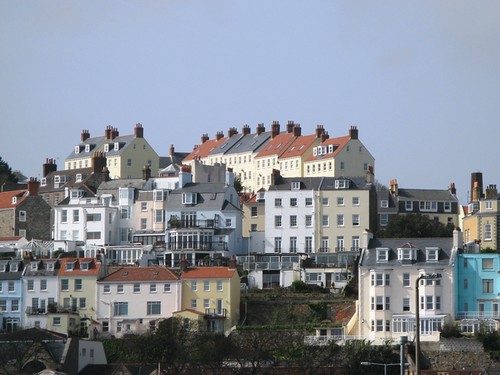
The photograph above is of St Peter Port in Guernsey. A darling little town and it was no trouble at all to write a paragraph about it. The hard part was keeping it down to the 250 words required by the competition terms.

The Qantas lady congratulated me again, the call ended, and I pulled into a government office building to collect a public servant for her trip to the airport. She must have wondered why she had the happiest cabbie on earth as her driver!

22 January 2009

Marooned


Some nights I do things I’m not proud of. But my work isn’t entirely delightful old ladies flirting with the cabbie, or returning tourists swapping travel tales. Sometimes I have to put the driver ahead of the passenger.

Thursday night. It’s what they call “Uni Night”, and the clubs in Civic cut their prices to attract customers who would otherwise stay at home. Not the after-work drinkies of Friday, nor the solid frenzy of Saturday, Thursday night is Uni Night, and it’s when the cheap drunks go out on the town.

The drinks are half price, and this means two things. First is that some people drink twice as much as normal. Second is that the cheapskates drink the regular amount. Either way, they are not necessarily the sort of people I want in my cab.

You get a better class of drunk on Friday. People with money in their wallets. People who can handle their grog. People who can carry on a civil conversation. Mind you, as the night progresses, the drunks become increasingly ratty, but on Friday, they start from a high base, and by the time I finish up at three in the morning, they aren’t too bad.

Tonight there’s been thunderstorms hanging around. I scored at the airport early on. A young lady got in and said “Dunlop”. That’s about as far west as you can get in Canberra, with the state border only a couple of hundred metres away. Nice long fat fare and it’s freeway most of the distance. Once I dropped her off, I headed in to “Bernies From the Bay”, a fish and chip shop at Charnwood. Not healthy tucker, but they do a very good grilled fish and chips. Especially the hand-cut chips.

I ate my dinner outside, under the awning, just as a storm came through and dumped a lake full of water on Canberra. Luckily I was sheltered enough not to worry, but Lord, what a deluge!

I finished my meal and followed the storm all the way back to the airport, spectacular lightning strikes ahead of me, puddles on the road, the setting sun lighting up the landscape under the dark clouds. Spectacular.

I did a few airport jobs and when the planes stopped landing, hit the main Civic rank. By half past one, I was dubious. There was a long line of cabs on the rank and the drunks were looking very ratty.

Two young men got in and gave an address in one of the northern suburbs. The guy beside me was fine. He was almost sober, in fact, but his mate in the backseat was gibbering. Calling me names, talking at random, telling me how drunk he was.

We pulled up at the sober bloke’s apartment block and he paid me with a generous tip, while his sozzled mate got out and gave the flower beds a watering. Then he climbed back in for the second half of the trip, out to Gungahlin. The address he gave sounded implausible, he was extremely drunk, his financial status was uncertain, and he’d cranked the window down - never a good sign.

“Just pull into the servo, willya? I need some fags.”

The good old cigarette stop for the nicotine addict. Every cabbie knows it well.

Every cabbie reading this also knows what was on my mind, as I pulled in beside the service station for my passenger to get out and buy his cigarettes.

He left the cab door open, but that was no problem. I gave him maybe ten seconds and hit the gas, the door swinging shut as I peeled back out onto the road. He came back out and peered forlornly after me, but I was too far away and moving too fast.

I’m allowed to refuse people under the influence of alcohol or drugs, so I was within my rights. I’ve spent far too much time and money on passengers who fall asleep, throw up, run away without paying, abuse the driver, leave rubbish in the cab or some combination of the above. I’d had a very good look at this guy, and as well as being very drunk, he was pressing all the wrong buttons with me.

I don’t feel good about leaving him stranded, but then again he was on the main shipping routes of Canberra’s cab world, and he wouldn’t have waited too long before finding a less wary cabbie.

Or walking home. I sure hope he didn’t try walking home, because about fifteen minutes after I left him, there was a second rainstorm, dropping another Sydney Harbour’s worth of water on Canberra.

Just as I was taking the cab through the carwash to remove the mud spatters from the first storm. I’d had enough of ratty drunks and I deserved an early night.

21 January 2009

The heat of heart


I ended my shift early last night, stocked up on hot dogs, sarsaparilla (another name for root beer, apparently) and Oreos, and staked out a position on the couch for the Obama inauguration. The Good Morning America coverage began with a shot of the Mall just as the first rays of the morning sun were lighting the tip of the Washington Monument, and already the space was crowded, with streams of people flowing in. By noon it was a solid mass of onlookers, all there to be a tiny part of history.

The GMA crew interviewed the spectators, asking, “Who has the most layers of clothing?” It was cold. Cold with windchill.

I’ve been there. I’ve walked through a bitter pre-dawn in Washington DC, and I’ve crunched across the Mall covered in fresh snow. That was exactly four years ago, the day after the second Bush inauguration, so I knew exactly how cold it was for the swelling crowd.

My wife and I had the city to ourselves then, and we spent a sparkling afternoon exploring the Smithsonians and marvelling at the wealth of art in the glittering halls of the National Art Gallery. But eventually the early twilight drove us outside, where we looked for a place to hail a cab. Most of the street was lined with parked cars, but outside an impressive building on Constitution Avenue, there was a clear space, albeit lined with the ugly cement barricades that have sprouted like toadstools in the years following the 9/11 attacks. I set down my heavy tote bag with a sigh of relief and in a few moments a cab drew up beside us, just as I became nervously aware of the approach of a couple of uniformed security guards. Heavily armed security guards.

We hustled inside the cab and sped off.

“Crikey,” I said to the cabbie, a silver haired gent, “What’s the story there?”

“That the Department of Justice,” he replied. “They antsy over Gitmo.”

Guantanamo Bay, where terrorist suspects were detained, had been the subject of some fairly high-level protesting in the weeks before our visit, so I guess that anybody carrying a bulky bag might arouse suspicions. After all, Washington itself had been attacked in 2001, and there were good reasons to be antsy.

The cab itself was an old model. Beautifully clean and tidy, but definitely showing the signs of a long life as a hack. I learnt later that the tax regime made it uneconomical to buy new vehicles, so cabs were operated until they fell apart, and this one didn’t have long to go.

We rattled through an intersection and I nudged my wife. “Look, the White House!”

“Yeah,” said the cabbie, “they got the wrong guy in there.”

We chatted the rest of the way to the hotel. He was interested in Australia, and we told him about the wildlife and the climate, stressing that we didn’t see much snow there. In fact it was summer right now, and we’d come straight from 30 degree heat to this snowy, subzero environment.

“Might move there,” he mused. “Might marry up one of them native girls, hey?”

We assured him that there was always room for taxidrivers in Australia, and gave him a small tip when he dropped us off at our hotel.

So when I saw Washington DC last night, looking frosty in the winter air, and joyous in the atmosphere of celebration, I remembered my own first fond impressions. Compared to Canberra, it’s a very different city, but there are similarities - the broad ceremonial avenues, the grand public institutions, the monuments and memorials. It’s a place where I can feel at home on the far side of the world.

“Aren’t you cold?” asked the television interviewer of one lovely old black woman, showing all her teeth in a fabulous smile.

“No, honey, I got my heart to keep me warm.”

There were a lot of happy hearts in Washington. A million strong, they thumped away and surged with excitement when Obama came out to take the oath. The sight of that sea of flags waving in a joyous tumult was unforgettable. I wish I was there, to share the excitement, to wave a flag, to feel the warmth of history and a glorious new dawn.

And somewhere, maybe in that crowd, maybe parked on a side street, listening on his cab radio, I am sure that there was one very happy cabdriver.

20 January 2009

Time for change


I’ll be giving myself an early mark tonight, ending my shift before midnight to drive home for the broadcast from Washington. I’ve got some hot dogs, buns, onions, American mustard and for dessert, Oreos. I’ll see if I can find a bottle or two of root beer, but it’s hard to come by in Australia. I can always fall back on Pepsi, I guess.

Four years I got into Washington just after the second Bush inauguration, and it was a cold old town. Bleak in the snow, ice covering the Potomac, and homeless finding shelter amongst the grand monuments. But there were shops chock full of unsold red white and blue caps, buttons, scarves and nosewarmers. In the days afterwards I virtually had the place to myself, examining the Hope Diamond at leisure, and sharing the “Rotunda of the Charters of Freedom” with only a handful of other visitors, despite the fact that all of the grand institutions in which I rattled around were clearly set up for thousands.

This time around, there are going to be millions of visitors. Whole communities are hiring buses for the drive in. They want their piece of history. Washington will be a city buzzing with excitement, and I wish the local cabbies, creaky old black gentlemen every one of them, a windfall profit.

In Canberra, it’s hot and quiet. You could fire a cannon down any main road and not hit anybody except maybe a lonely cabbie looking for pedestrians.

There’s a bit of work available, but what is it with everybody in January? Does nobody have anything smaller than a fifty dollar note?

I start out with a float in my money bag. Two twenties, two tens, two fives and whatever coins I can cram into my dispenser, usually heavier on the silver than the gold one and two dollar pieces. I might have a few notes as a reserve in my wallet.

The first passenger offering a fifty I welcome with a smile. But the average fare is fifteen dollars and giving change for that wipes out half my float. Still, it can’t be helped, and I tuck away the golden yellow bill, known as a “pineapple” for its colour.

The second is greeted with a groan and the third pineapple just reams me out completely. I’m reduced to making change in handfuls of coins.

My wife doesn’t help. She raids my wallet for cash before departing for work, and at the rustle of notes I’ll wake from a sound sleep, muttering “take the fifties, take ‘em all, just leave me the little ones!”

Yes, it’s true - I love the little five and ten dollar notes with a passion. Give me a thick wad of the small notes and I’m the happiest cabbie that lived, but if I have a fistful of fifties, I’m haggard and wary, looking suspiciously over at my passengers as we near the end of the ride.

Which, of course, brings me to the classic old taxidriver story.

A late night cabbie, much like myself, was cruising the streets when he spotted someone flagging him down. Just an arm frantically waving, and a desperate face peering around the corner of a hedge.

He drew up to the curb and a stark naked woman raced across the footpath, flung open the door and dived into the back seat.

“Thank god you stopped,” she said. “The wife came home at the wrong time and I didn’t have a moment to...”

She stops as she realises the cabbie hasn’t driven off yet, and in fact is staring at her through the rear vision mirror.

“What’s the matter?” she snaps. “Haven’t you ever seen a woman before?”

“Well, yes,” the cabbie says slowly, “but I was just wondering how you intended to pay the fare.”

She leans back and opens her legs. “Will that do?”

“Awww, geez lady, don’t you have anything smaller?”

18 January 2009

A month of Sundays


January is the month Canberra cabbies hate. It's the middle of summer and it seems that everyone but the taxidrivers are off on holiday. Long days and nights waiting on motionless cab ranks, reading newspapers.

"It's great for passengers," I tell people more used to long delays, "and that's the main thing, isn't it?"

Happy passengers equals happy cabbie, I say to myself, but there are limits. Much as I enjoy taxidriving, when I check the meter and it comes out to something like five dollars an hour after tax for a job with no leave or benefits, I have to wonder.

Come February, it will all change. Schools start up again after the break, the defence academies will be loaded up with cadets, the public service returns to life, and then Parliament will resume, overloading the taxi system once again.

It’s boom or bust in Canberra, and January is bust. The morning and afternoon peaks have disappeared. Normally there’s a period of a two or three hours where I’ll be offered more work than I can possibly take, usually taking people to the airport to catch the evening flights out. For two hours I’ll be running a shuttle service to and from the airport, and I won’t have a moment to scratch myself. Then it dies down and I’ll find somewhere around six o’clock to have my dinner.

January, I sign on and look at the statistics screen. There’s a flood of taxis booked solid into every despatch area, and a scattered few fares or upcoming jobs. From the moment I book into an area, I’m competing with other hungry cabbies. I’m eating my dinner at four, contemplating a long wait for my next fare.

Lately, I’ve been watching movies on my iPhone during the slow times. Movies and books and newspapers - January cabbies have to be patient.

15 January 2009

Sleeping on the job


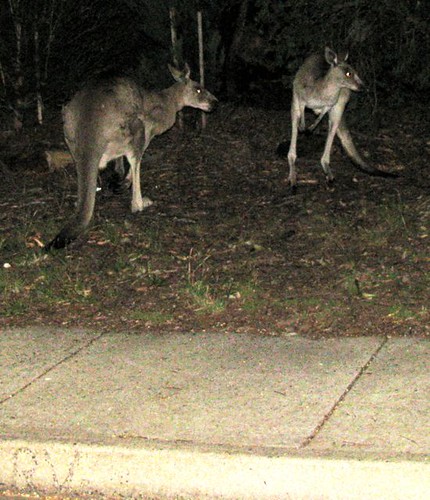
People ask me about the worst parts of the job. “Picking up the drunks on Fridays and Saturdays?” they suggest, but no, it’s the kangaroos that give me the most stress. They jump out in front of you without warning, and can do a great deal of damage. Occasionally they kill people, especially if they go through the windscreen.

“But don’t you have trouble with drunks?” they ask. Well, yes, but not in the way one might think. The chap above is a textbook example of the sort of drunk that gives me the most trouble.

I spotted him in the early hours of Thursday morning, dozing on one of the bus shelter benches at the main Civic rank. These benches are designed to deter sleepers, having low armrests which make it impossible to stretch out. This chap would doze off, wobble left and right until his head was dangling like a ripe plum, and then the discomfort would jerk him upright again. Amusing to watch, and as I had a moment to spare, I pulled out my camera to take a couple of photographs.

A couple of reasons why he wouldn’t make a good passenger. First, he was obviously very drunk. When people don’t feel comfortable staying upright, they are a good chance to throw up in the cab. Secondly, he was obviously sleepy, and when a passenger goes to sleep in the cab, it can be very hard work indeed to wake them up again. Thirdly, he was hanging around the cab rank on a quiet night. If he wanted to get home, why didn’t he just get in a cab and go home?

I moved up to the head of the rank and picked up a fare. Just a short one, but that’s the chance you take. Sometimes you get a fare to a distant suburb, sometimes to a hotel a few blocks away. It all evens out.

When I got back to the rank, it was after two in the morning and I was starting to think about getting the car gassed up, cleaned out and home for the day driver. One more fare would make my night.

A couple of young women headed towards me, but were intercepted just shy of the cab by a friend and after some discussion, they disappeared. Half past two and I was on the verge of giving up for the night when the door opened and the sleepy subject of my photograph above slipped in beside me.

He named a suburb near Woden, and then must have keyed off the expression on my face. “I’ve got money to pay,” he assured me.

I generally find that when passengers have the money to pay the fare they don’t bother to tell me up front. It’s just assumed.

Anyway, he was in my cab and the fare was a reasonable one, so I headed off.

“Bit cold in here.”

I cranked the heat up. Big mistake. A few minutes into the ride and he was nodding again. I asked him for his address, just to make sure.

A minute later he was fast asleep, but I figured that I could wake him up on arrival. Usually turning the airconditioning on full blast and putting the sound up to extreme is enough.

It wasn’t, not this time. He was out for the count. Shouting at him didn’t produce so much as the flicker of an eyelid.

At that point my chance of a good result dropped to zero. I’m not going to touch a sleeping passenger. Not if they are an attractive young lady, and not if they are a tattooed young man in football kit.

I put the car into gear and headed for the police station, luckily only a few minutes away. It took me a bit of time to stir the police on duty into action, but eventually they came out to me, pulling on gloves.

It took them a few minutes, pushing on my passenger’s chest and speaking very loudly to him, before he came around. They found his wallet - empty - and looked at me.

“I’ve got to be on the northside in five minutes,” I said. “He’s got no money, and he’ll just fall asleep again.”

“We’ll get him home,” they promised.

So they took him off my hands, and I cleared the meter of the thirty three dollar fare. That’s sixteen-fifty straight out of my pocket, not to mention half an hour of my time.

Luckily I’ve got an understanding day driver, who merely smiled at my story when I delivered the car late and unwashed.

09 January 2009

Taxi TV


If there’s one thing I like about cabdriving, it’s listening to other cabbies. Every cabbie has a stock of stories about life in the city, late night people, love and lust and all of the other sins. It’s a never-ending drama full of bit players and the occasional star.

“Every single shift is different,” said Gerard Donaghy, one of three cabbies invited onto an evening talk show a couple of years back. The host, no slouch at telling stories, just sits back and lets them go at it. It’s marvellous reading, and it must have been great television. The transcript is full of marvellous phrases, pungent and provocative.

...being a cabbie is, kind of like, you don't have to travel the world, the world comes to me...
...you become, like, a Liberal Socialist Communist Buddhist...
...late at night you get a bit aroused...
...I thought I'd turn on the interior light. Well after that, I turned it on, there was a massive loud scream. Very loud scream....
.... it went off in the back seat and it was all up the side of my ears and down the back of my shirt. It was on the windscreen...


Marvellous material. I wish that I could record some of the stuff that goes on in my cab. Have a button I could push to save the last half hour of security camera footage. Most of the time it’s talking about the weather, or listening to girls talk about boys, or boys talk about the footy, but every now and then there’s a few moments you’d like to bottle up and keep forever.

Which is why I keep a blog, I guess.

04 January 2009

Cabbie fun


A guy in a taxi wanted to speak to the driver so he leaned forward and tapped him on the shoulder.
The driver screamed, jumped up in the air and yanked the wheel over. The car mounted the curb, demolished a lamppost and came to a stop millimetres from a shop window.
The startled passenger said “I didn’t mean to frighten you, just wanted to ask you something.”
Taxi driver says “Not your fault Sir. It’s my first day as a cab driver; I’ve been driving a hearse for the past 25 years”.

A cabbie classic that one. The cartoon is closer to home. Things go wrong with cabs all the time. Especially with some of the older cabs, a million kilometres on the clock and years of life left in them. Bits rattle loose, one speed bump too many, passengers tinkering with the moving parts, or just old age sneaking up on cab and cabbie alike.

And what’s a night driver to do when the workshop is closed, the defect isn’t serious, and there’s people lined up to be driven home? Naturally, the 24-hour servo is the handy-dandy patchit shop, and a roll of duct tape is just the thing to hold a wobbling wing mirror straight. Next time you load your bags into a taxi boot, check out the corners. Like as not there’ll be a couple of elastic straps, the kind with hooks on the ends, tucked away somewhere. You can hold a cab together with octo straps, and if there’s more luggage than the boot can easily contain, just pile it in and use the straps to hold the boot lid down on the trip.

Had to laugh the other day. Driving up Commonwealth Avenue towards Parliament House, and there’s a ratty old Holden Commodore parked on the median strip, a gaggle of young guys standing glumly around. The car had obviously been in a recent shunt, because the front end was slightly bent, bonnet buckled, bumper missing. But obviously drivable, because the bonnet was held on by about a kilometre of duct tape. Checking under the hood would be a major (and expensive) exercise.

My guess is that the lads had come to Canberra to attend the annual Summernats car festival, a three day event where young men spend all their money on petrol, junk food, beer and birds. They head back home on the Sunday, sunburnt a blistering red and running on the last fumes of their credit cards.

Naturally, the local police call in all their reserves for this weekend, which they spend cruising up and down looking for galahs. They haul them over by the dozens, breath-testing drivers, issuing defect notices, speeding tickets. This car held together by tape wouldn’t have lasted long.

I would have stopped to take a photograph, but I had a passenger beside me, and so the opportunity was mist.

My cab’s safe for the weekend. The owner called in my day driver last week, giving us three new tyres and replacing some burnt-out lights. We’re street-legal again.

The cartoon and joke above courtesy of the Irish Taxi website, though I suspect that the cartoon was borrowed from somewhere else. Africa, Ireland, Australia, cabs and cabbies are pretty much the same the world over.

03 January 2009

Happy cappie


There I was in St Malo, fresh off the boat from Guernsey, where I'd bought a fair dinkum guernsey. A thick blue woolen jumper as worn by Guernsey fishermen for centuries, and now sold to tourists. A lovely warm garment, but I was feeling very self-conscious, so when Kerri suggested I buy one of the Breton fisherman caps, as sold in every single one of St Malo's many souvenir shops along with the chocolate fish and the wooden lighthouses, I declined.

Since then, I've gone through a Canberra winter loving my guernsey. If there's a nip in the air, I snuggle into its baggy blue comfort.

So happy am I with it, that I'm sorry I didn't buy a Breton fisherman cap to go with it. Next time, I told myself. Brittany is a long way to go for an item of headwear, but well worth the trip.

Williamstown last week, and we (Ken and his charmant parents) had just finished lunch, settling it down with a walk along the Gem Pier. While the older two ventured aboard the museum ship HMAS Castlemaine - "They served aboard during the battle of Jutland!" I yelled from the pier, hoping to score them a discount and maybe a quick spin around the bay - and Ken remained perforce ashore in his wheelchair, I went back to move the car to a better position.

On the way, I noticed that the maritime historical society was having a sale and of course, I stuck my nose in. A half price brass divers helmet us still enough to put a dent in even the boldest credit card, but amongst the t-shirts and compasses I noticed a pile of dark blue caps. Breton fisherfolk caps. Half price!

I'm sorry now that I didn't buy two, but I guess I can always go back.

It will go well with my guernsey, but I also had my Silver Service uniform in mind. I like a cap or hat to cover my bald spot in sun and cold and the official wide brimmed uniform slouch hat is quite impractical in a car. Other drivers wear non- uniform baseball or flat caps, but I hadn't seen anything that I truly loved.

Until now.

I felt a little self-conscious at first, especially when other drivers pulled up alongside and peered curiously in at me, but all my worries evaporated when on of the older drivers smiled and said, "That is one righteous cap!"

31 December 2008

Melbourne cabs


Love him or not, Jeff Kennett left a lasting legacy from his time as Victorian Premier. He reorganised Melbourne’s taxi system, directing that cabs be painted yellow, that drivers wear uniforms, and a number of other things. The drivers themselves might be as mixed a bunch as in any other city, but there are some proudly carrying the torch:

FAITH is central to Mohammed Jama's life. In keeping with his Muslim beliefs, he prays five times a day, often driving his taxi to a mosque in King Street mid-shift to carry out his spiritual obligations.

Jama, as he is known, keeps a tiny copy of the Koran discreetly on his dashboard, but don't ask him to discuss religion while he's driving; he has nothing to say on the matter since such conversation between Melbourne taxi drivers and their passengers was banned by the Victorian Taxi Directorate.

Likewise, don't expect a lively debate about the state of Australian or global politics; that's also a no-go under VTD guidelines.


Full story here in an article from The Age.

Driving to Melbourne and back, I didn’t need a cab, but I was impressed with the look of those I saw. They look clean and bright.

I relied upon my own Navman GPS, now nearly three years old, for directions. I didn’t have a copy of Melways, Melbourne’s excellent street directory, and although I have a rough idea of the layout of the city from living and working there twenty years back, there are a whole stack of new tollways and tunnels. Some of them aren’t in my Navman at all.

Driving down, with Ken beside me, I had his helpful guidance. Even so, the Navman directed us far too close to the CBD for my liking. In fact we drove along beside the Melbourne Cricket Ground, where the first of the crowd were beginning to straggle out from the stands. Another half hour and it would have been rush hour on what was all but a holiday.

Coming back from Frankston, I ignored the GPS advice for the most part. It seemed bent on steering me into the city before letting me out again. Instead I peeled off the freeway well east of the city centre and headed north. For the next half hour I tried to angle my way across a relentless grid, rapidly losing all but a rough idea of direction under the overcast sky, through a series of unhelpful signs bearing names of unfamiliar suburbs. I’d hit a junction: left would be Bungey, right Page, and Gullett ahead. Which way to go?

Eventually I found my way through Bundeela and saw a sign for the Hume Freeway, heading north. But without a street directory and under the guidance of a machine which reckoned the congestion of the CBD to be part of the swiftest route, it had been an uncertain trip.

Smart yellow cabs or no, I’m very glad that I’m not a Melbourne cabbie. Melbourne is too big to know well. No cabbie can be intimate with every street in every suburb. Not to mention the traffic. Canberra’s peak hour lasts an hour, and only along a handful of streets. In Melbourne, you can get gridlock lasting for hours.

Canberra has a well laid out system of arterial roads. Traffic flows smoothly along wide roads through dedicated reserves. Suburbs are clearly defined and grouped into town clusters. It’s just a joy to drive in Canberra.

Eventually I left Melbourne’s grid of trams and traffic lights behind, seven hours of freeway driving ahead. Melbourne’s a nice place to visit, but I wouldn’t want to work there.

27 December 2008

Long fares


I’ve had all sorts of people in my cab, sharing a moment in their lives. Politicians, judges, artists, sportsfolk, authors: people whose doings and photographs fill newspapers. And the ordinary every day folk who are fascinating in themselves. We share a story, a joke, an observation, and I go on my way chuckling, or thoughtful.

But of all the passengers I’ve carried, by far the most fascinating, the most unforgettable is Ken Haley.

He’s an author, a world traveller in unlikely places, and he’s in the newspaper just about every day.

That’s because he’s a journalist, currently working as a sub-editor on The Canberra Times.

He has a memory crammed full of trivia, every Monty Python or Pete&Dud skit, a stock of quotes from movies and books and famous figures of history, and a love of puns and wordplay that made me his adoring fan after a few minutes in his company.

He’s written a book or two, and I’ve read and reread my copy of his quirky travel book, Emails from the edge. Now I’m waiting for the next adventure to be published. I’ve seen the manuscript on his kitchen table, and I long for the day when I have my own copy to add to my collection of Morris, Theroux, Chatwin and other great travel writers.

He’s all these things and more: he’s a paraplegic. Half man, half machine, I have to position the cab carefully to allow him to come alongside, transfer his bum into the front seat, and then shift his disassembled wheelchair into the back seat.

The result of a breakdown and attempted suicide, Ken’s paraplegia doesn’t stop him getting into places where most people would fear to tread. Places like South Ossetia, Syria, Botswana (where his taxidriver managed to get bogged in the only mud puddle in the nation).

He roams the world in a wheelchair, vital medical supplies and spare parts in his baggage, finding willing hands in unlikely places.

He pulled up beside my cab on Manuka rank one evening, and when I realised that instead of some fetching young lady leaning in my window, there was a head bobbing around at hip-height, I leapt out of the cab.

When I see a walking stick, a pair of crutches, a Zimmer frame, or a wheelchair, I know that the passenger has a genuine need for assistance, and I do my very best to supply it. People with mobility problems depend on cabs and cabbies to get around, and when you can’t walk, things as simple as popping down to the shop for a loaf of bread can become time-consuming and expensive adventures.

I like helping people, but I suspect that the real reason Ken keeps calling me when he needs a taxi, and I drive like a demon across town to be there, is that I laugh at his jokes.

Every trip with Ken is a delight. I chuckle happily, or listen enthralled, all the way home. Sometimes the trip is not enough, and I stand in his doorway, demanding more entertainment, until the lights on the cab begin to fade out.

There’s a legend in the lives of cabbies of the mother of all long fares. The lady who walked up to a cab rank in Sydney one day in the 1920s, asked “Do you take long fares?” and when an affirmative reply was given, asked to be taken to Sydney, the long way.

After visiting every mainland State and Territory, she paid the fare and walked off into history.

Ken related the story to me with gusto, and ever since, I’ve lived in hope and terror that the day will come when he wheels up to the door and asks, “Do you do long fares?”

Well, that day has come. We’re off to Melbourne in a few hours.

26 December 2008

The worst part


“It must get hard,” people say, when I tell them I drive the night shift. “Don’t you have trouble with the drunks?”

Well, yes, sometimes, but I take the position that everyone is entitled to a few drinks with their friends, and after a few drinks, you can’t drive, it’s too far to walk, the buses stop running at midnight, and how else you gunna get home, hey?

I have very little trouble with drunks.

The crazies give me more bother, but there’s none too many insane people wandering the streets of Canberra, despite what the rest of the country thinks. A few on the fringe, but they are more entertaining than scary.

“Nah,” I say, “it’s not the drunks and it’s not the crazies. It’s the herbivores.”

And that’s a fact. The absolute worst part of this job is the kangaroos.

It was the middle of a prolonged drought when I began cabdriving, and after dark, or indeed at any time of the day or night, you could find kangaroos browsing on the few patches of green, mainly the grassy verges of the main roads, or in suburban gardens.

I’ve seen them in the Parliamentary Triangle in mid-afternoon, attempting to cross six lanes of rush hour traffic on Adelaide Avenue outside the Prime Minister’s Lodge, bounding across the top of Hindmarsh Drive before sunset, two unlucky cars ahead, and of course after dark, they flood in from the surrounding bushland, looming up suddenly, five metres high, as I round a suburban corner.

Other nations have sacred cows, or deer, or elephants wandering through the streets, but in Canberra, the bush capital, the roos rule the road.

They can be big creatures, somewhere between a dog and a horse in bulk and speed, about as clever as your average chook, and mainly distinguished form other creatures by their long muscular legs, top-heavy appearance, and curious bounding movement. They move at speed by making long jumps, using the muscles and sinews in their legs to store energy as they land and then taking off again.

At full speed, they can appear out of a dark nowhere, up around windscreen height, in the space of an eyeblink. They don’t pause on the side of the road to peer nervously left and right, oh no, they jump across at full speed. And where there is one kangaroo, there is usually a mob of them. You can go in a heartbeat from being alone on a night road, your headlights picking out nothing but the white lines, to being surrounded by hurtling herbivores.

Kangaroos scare me. When you get down to it, they are just a big ball of muscle with sharp claws on the ends, and the thought of one of them crashing through the windscreen and thrashing around in the front seat is what gives me nightmares. People die from kangaroos: torn up behind the wheel, driving off the road or into other cars, or just from a heavy body suddenly demolishing the front end of the car.

Driving along at night, I see other creatures. Cats scamper across streets, foxes look up and down the road before picking their moment, and cows are big enough and slow enough to be seen from a safe distance.

But kangaroos are right there in front of you without warning. Twice I’ve had them jump out from roadside vegetation into my path and there was nothing I could do to avoid them.

The first one bounced off my passenger side quarter, taking out the headlight and half the bumper. The second one went under the car, taking out a headlight and half the bumper before demolishing various bits of the underneath machinery.

Both times, I was at the end of my shift, able to limp home on a single headlight with a surprise for the day driver. I was lucky to drive away.

“Bloody things!” I say to my passengers when they ask me about the worst part of my job. “Bloody kangaroos give me the screaming nightmares.”

That’s why I drive tense, hunched over the wheel and peering nervously into the dark, flipping on high beam whenever I can. My fellow human beings might be mad as cut snakes, sick up in the back seat, or run off without paying, but they are saints and angels compared to those bloody bounding kangaroos.

25 December 2008

Christmas Cabbies


My days are about forty-eight hours long. It’s not that the night shifts stretch out interminably - on the contrary, the hours flash by - but that I’m always conscious of the hours before and after Canberra’s day.

About the same time as I flip the meter onto the night-time rate, it’s midnight in New Zealand, where so many of my friends live. I drive through the dark, wash the car and crawl into bed on Thursday morning, but it’s still Wednesday for another six hours in Europe. And in the USA, where so many of my Internet friends live, it’s just about always yesterday. They must think I’m a being from the future sometimes.

And occasionally, I have a very long day indeed when I’m travelling with the sun. Typically Hong- Kong to Heathrow, but the longest Friday of my life had two dawns and two dusks, from waking up in Canberra to falling asleep in Washington DC, with a midnight pass over a glowing Hawaiian lava field somewhere in the middle.

For me, Christmas Day was yesterday, spent on the road up to Gosford, having lunch and a lazy afternoon, and then driving home again. But it’s still Christmas in other parts of the world.

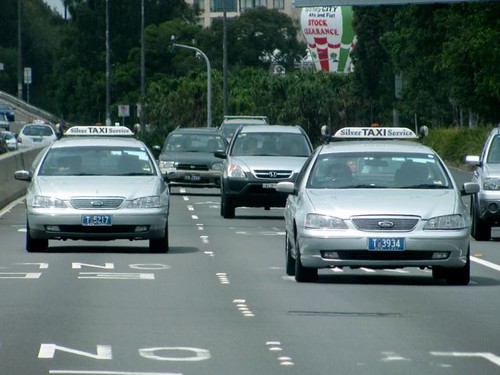
We passed through the centre of Sydney on the way up, and, waking from sleep in the back seat whilst my wife and daughter shared the driving, I took a picture of two Sydney Silver Service taxis returning from the airport. My day driver later reported in, saying that he was having a profitable shift.

One cabbie was doing very well, I noticed. We were stuck in a creeping traffic jam from North Sydney to Pymble where the north coast freeway begins, and amongst all the grim-faced drivers was a happy cabbie crawling along beside us. And a couple of grim-faced passengers in the back seat.

We had a delightful lunch with my sister’s family, including my mother down from Rockhampton, played with the toys scattered about in various stages of assembly, experimented with Skypevision with other family members and just had a grand time before it came to an end too soon and we had to be back on the road.

Christmas is a special time in the Western world. My day driver and I exchanged presents, he dressed up in a Santa cap for his Christmas shift, and every single passenger I had on Christmas Eve wished me a Merry Christmas, often with a nice little tip.

Good humour, fellowship and smiles are the order of the day.

It’s been a great year for me. Sometimes I feel that it’s Christmas every day. Sometimes I just have to stop and savour my delight. Driving around the Arc de Triomphe was a highlight, as was kissing my wife on top of the Eiffel Tower. Looking out for giant gorillas on top of the Empire State Building, walking through the entrance to the National Building Museum in Washington, watching the incredible light show on Hong Kong Harbour.

Giving a helping hand to a lady in need, swapping travel stories with tourists picked up at the airport, singing along to Abba with some party-goers, laughing at the wicked wordplay of one of my regulars, hanging out with other cabbies - it’s been a blast.

Or just driving along a deserted freeway in Canberra, a favourite song playing as I pass some floodlit monument in between passengers. A happy cabbie.

But one moment sticks in my mind. Yesterday morning Paul and I wished each other a Merry Christmas as we sat in the front seat of the cab parked in my driveway. I’d finished my Christmas Eve shift, he was starting his Christmas Day, and we just sat and chatted for a few minutes.

Another cab passed by, stopped, reversed, and the driver got out. It was Geoff, who happens to be Paul’s father-in-law. We swapped more greetings, shook hands and then he was gone, Paul fired up the car and drove off, and I went back inside, very very happy with my job, my life, my family, my friends and the world in general.

It all comes back to what I answered on my taxi driver course two years ago, when we were asked, “What do you expect to get out of being a taxi driver”.

I thought for a moment and wrote down, “A lot of company for a short time, and a few good friends for a long time.”

The instructor looked at this and said, “You’ll have no troubles.”

And he was right.

Merry Christmas, everybody!

24 December 2008

The Cabosphere


I’d never taken much notice of taxis or taxidrivers before. Colourful characters in colourful cars. Part of the background. Lined up here and there, scurrying along city streets, minor characters in movies.

And then, when I became a cabbie myself, suddenly everything was cabs. I’d look at a line of cabs, pick out the tiniest details and point them out to my wife. I bought “Taxi Driver” to relish in Robert de Niro. I scoured the internet for taxi stories. I started my own taxi blog. I wrote copious accounts of my adventures.

I was hooked, plugged into a life I’d only guessed at before. The crackling radio conversations of codewords - suddenly they became clear.

Other taxidrivers fascinated me. We’d chat on ranks, occasionally I’d drive one home - mates rates - from a club, interstate or international cabbies would jump in at the airport. I relished the chance to swap stories with other cabbies. Each yarn would spark another memory, of runners, pukers, singers, jokers, kangaroos and caribous.

When I travelled, I’d go hunting taxi adventures, hauling my big yellow bags to a tiny yellow taxi, jumping in beside the driver in Frankfurt, Chicago, Hong Kong and swapping tales.

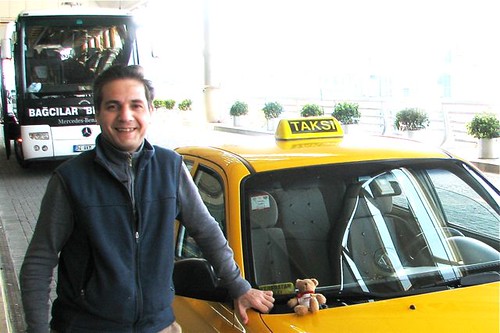
Hasim in Istanbul handed me his business card at the airport, with an email address of “Sultan of the Taxi”, posed with RingBear, and drove away out of my life.

Melissa Plaut encouraged me with my blog and when her superb book “Hack” was published, I bought my own copy, fresh mail-order from Amazon. I devoured the hilarious tales of a taxi despatcher in Arlngton, cabbies in Hawaii, London, Canada.

And I’m still loving it. There’s not enough hours in the day to drive a shift, read up on the blogs, and write up my own adventures. But I try.

And, in what may be a first for the cab sector of the blogosphere, my day driver Paul is tag-teaming with me. Two drivers, one car, night and day, the driver’s seat is never cold. His stories are my required reading, even when they’ve been summarised in a few words at shift changeover. He posts them in off moments from his iPhone, and he calls them Taxi Typos.

23 December 2008

Midnight granny


They were four young things, tweenie Australians out on the town, two from Perth giving their impressions of Canberra to a couple of locals as I drove them all home. A deserted freeway skirting Parliament House, the Prime Minister’s Lodge and the Mint. We owned Canberra.

“You’ve got the city planning down nice,” one said, “but it’s so far from anywhere.”

That was just great, I thought, coming from a sandgroper. Perth is three day’s hard driving across deserts and several State borders.

“It’s two hours to the beach,” said another. “In Perth it’s fifteen minutes max, and we can watch the sun set over the ocean.”

Fair call.

“Canberra’s public transport sucks.” The first one was on a roll. “The capital city and it sucks arse.”

No argument there, either. Canberra’s public transport consists of infrequent buses meandering through strings of suburbs. People sometimes accuse cabbies of going the long way, but with the bus system here, you get the maximum journey time for your money. And it stops running at midnight, long before the drunks get really ratty.

In fact, apart from the rare worker such as a baker beginning his shift, or a public servant burning the midnight oil when the government’s in a jam, it’s pretty much all drunks after midnight. Anyone else out at this hour has their own car.

So I was astonished to see someone waiting at a bus stop, getting on for two in the morning, after I delivered my four passengers home. It was a quiet night to begin with, and by now we cabbies were really scratching for fares. Luckily there were only a dozen or so cabs still on the road, so it kind of evened out.

I pulled up at the bus stop, and could hardly credit the sight. A little old lady, great-grandmother age, walking stick, sensible shoes, big handbag and floral dress.

She teetered over the kerb to me. “Are you a taxi?”

“Yes, hop in.”

Easier said than done, and I jumped out, scurried around the car, opened the door for her, tucked her in, made sure all was secure and closed the door.

“I can’t tell if it’s day or night,” she said, and then named a suburb about five minutes away.

Maybe she was blind, but she seemed to know where she was as we owned along Adelaide Avenue. “Turn here,” she commanded, not that I had any option for the address she’d given me. Canberra’s like that - there’s only a certain number of ways you can get somewhere, and if you don’t make the turn, you’ve got a long drive and a cranky passenger to recover.

I figured she was befuddled, as folk my age and up so often are, and when she mentioned that her knee and her back were hurting bad, I wondered if she had had one pain-killer too many earlier in the day. She spoke with an accent as she repeated her address a few times, and I reassured her that this was exactly where we were headed.

It was a small house on a pleasant street, garden overgrown, narrow driveway, letterbox vanished in the foliage. But it was the right address, I was sure of it.

She peered out uncertainly at the house in the headlights, and when I flipped on the side light to give more illumination, she nodded.

“That’s fifteen dollars fifty,” I read the meter for her.

“Fifteen dollars? So much!”

She was living in another time and place inside herself, a time when fares were cheaper, maybe measured in shillings and pence. “Fünfzehn Reichsmarken fünfzig,” I almost said, but instead, when she emptied out her purse, I picked out four gold coins and left her the silver. Not a note in sight. I’d go backwards on this fare, once I paid half the meter amount to the owner.

“Let’s get you out.”

I opened the door for her, made sure she had everything, and torch in my teeth, provided one arm to steady her and the other to carry her handbag as we tottered together along the narrow garden path. She peered about uncertainly, but when we reached the steps and she automatically latched onto the handrail, I was relieved.

It took some painful movements to get up the four cement steps, but we got there. She looked at the porch and declared, “This is not my house.”

The house in her mind was half a world and half a century away, so I suggested she try her keys in the door. We had a job finding them in her complicated handbag, but a flash of metal in the torchlight, and there they were. Naturally they fitted, and we opened the doors. I turned on her hall light, and she beamed happily as I passed in her belongings, finishing up with a gorgeous silk scarf. I’m very sorry I didn’t ask her to put it on for me, because there would have been a beautiful lady beneath it, but the thought didn’t come to me until later.

“Thank you so much!” she smiled. “Merry Christmas!”

“Merry Christmas!” I echoed. It might have cost me four dollars and half an hour, but for a Christmas gift, no diamond ring could have given either of us as much pleasure.

22 December 2008

Wintergarden


I’ve been reading another cabbie blog, and his description of a funny incident set my memory gears working. See Somebody did a doougie in this cab?! for the full horror.

I remember my first vomit incident. I spent an hour after midnight cleaning the cab out, and I couldn't smell anything. I couldn't smell anything, full stop.

My next fare was a lady in expensive clothing, she was only going a couple of blocks, but she didn't want to walk in heels. She opens the door and instantly recoils. "Has somebody been sick in here?" she asks.

"No," I lie.

She gets in, goes the two blocks and shoots out, telling me to keep the change.

Next fare is a bloke, well sozzled, and he jumps in, gives the name of a town just over the border, and starts telling me what an awful night he's had and his mates left him, and now he's got to pay for the cab all by himself without splitting the fare.

Then he starts sniffing and looks at me, and I look at him.

"Ah, someone threw up in the car yesterday," I explained. "Bloody day driver."

The road stretched out ahead of us, long and lonely. We wound the windows down and he stuck his head out of his, and I kept mine inside, cause I couldn't smell anything but the faintest whiff if I put my mind to it, and the floral scent I'd spritzed inside the car from the dispenser at the car wash was covering that nicely. Three minutes worth, you'd hope so. That was a buck well spent.

But my passenger was gasping. He was in genuine distress. It was midwinter and he wasn't coping well with the icy blast. He was a Queenslander, and they only have a pale imitation of winter there. It was well below freezing and even though I had the cab heater cranked way up, the bits of him that were hanging outside weren't happy.

I could almost see his mental processes going. He'd had a bad night, this cab was costing him a fortune - he kept glancing at the meter - he was freezing his head off, he was likely sitting in a pile of stale vomit and the lying cabbie was taking him the wilderness route - I'd automatically gone down the back road - and nobody cared. I could see him running off without paying.

We entered town and you could smell it, above the whiff of vomit, the cloying floral and the clean blast of icy wind. He was going to run. He was fully justified.

"Ah, it's half rates for interstate," I said, looking at the meter which had forty lovely dollars on it. "A twenty will be fine."

He paid me, and I gave up for the night. Took the car home, stripped out the seats, washed everything washable, found a few puddles of recycled pizza had seeped under the back cushion, and I aired it out for a day and hung up a couple of air fresheners on full flow.

And you know, it never smelt right. Months after, I just had to open the door at the beginning of a shift, and I was instantly wearing that lady's high heels, my sweet little nose wrinkling in outrage and dismay.

21 December 2008

Cabdriver in paradise


A priest and a taxi driver both died and went to heaven. St. Peter was at the pearly gates waiting for them.

‘Come with me’, said St. Peter to the taxi driver.

The taxi driver did as he was told and followed St. Peter to a mansion. It had everything you could imagine from a bowling alley to an olympic size pool in the extensive gardens.

‘Wow, thank you’, said the taxi driver.

Next, St. Peter led the priest to a rugged old shack with a bunk bed and a little old black and white television set.

‘Wait, I think you are a little mixed up’, said the priest. ‘Shouldn’t I be the one who gets the mansion? After all I was a priest, went to church every day, and preached God’s word.’

‘Yes, that’s true. But during your sermons people slept. When the taxi driver drove, everyone prayed.’

20 December 2008

Screen test


From the Melbourne Herald-Sun:

TAXI drivers have ended a city blockade after ugly scenes today, but vow to continue their protest over safety screens.

They called on the minister to change laws introduced this year that make it compulsory for owners to purchase and install safety screens, regardless of whether drivers want them.

Earlier, about 50 drivers were behind a related wildcat action that brought the Tullamarine Freeway to a crawl, with cars three abreast across the road from Melbourne Airport soon after 8am.

Thousands of city-bound motorists were forced to crawl along behind them at just 5km/h, causing morning chaos along the airport-city link.


Full story here.

I’m with the Melbourne taxidrivers on this. The day they make me drive behind some sort of plastic shield is the day I stop driving.

On the face of it, it seems like a good idea. Keep the driver safe from violent passengers. He doesn’t have to worry that someone’s going to pull a knife on him, or try to strangle him with the seatbelt.

Or kiss him.

The way to deal with crazies is to have the police deal with them. The message a safety shield sends is that it’s okay to have a go at the cabbie, we’re just going to make it more difficult to get to him.

For my part, I relish the personal contact with passengers. Sure I’ve been worried about some of them, but nobody’s ever offered me violence or threatened me. On the other hand, I’ve had a few kiss me or shake my hand, and that means the world to me. It means I’m doing my job right.